
 Guest Post Hub
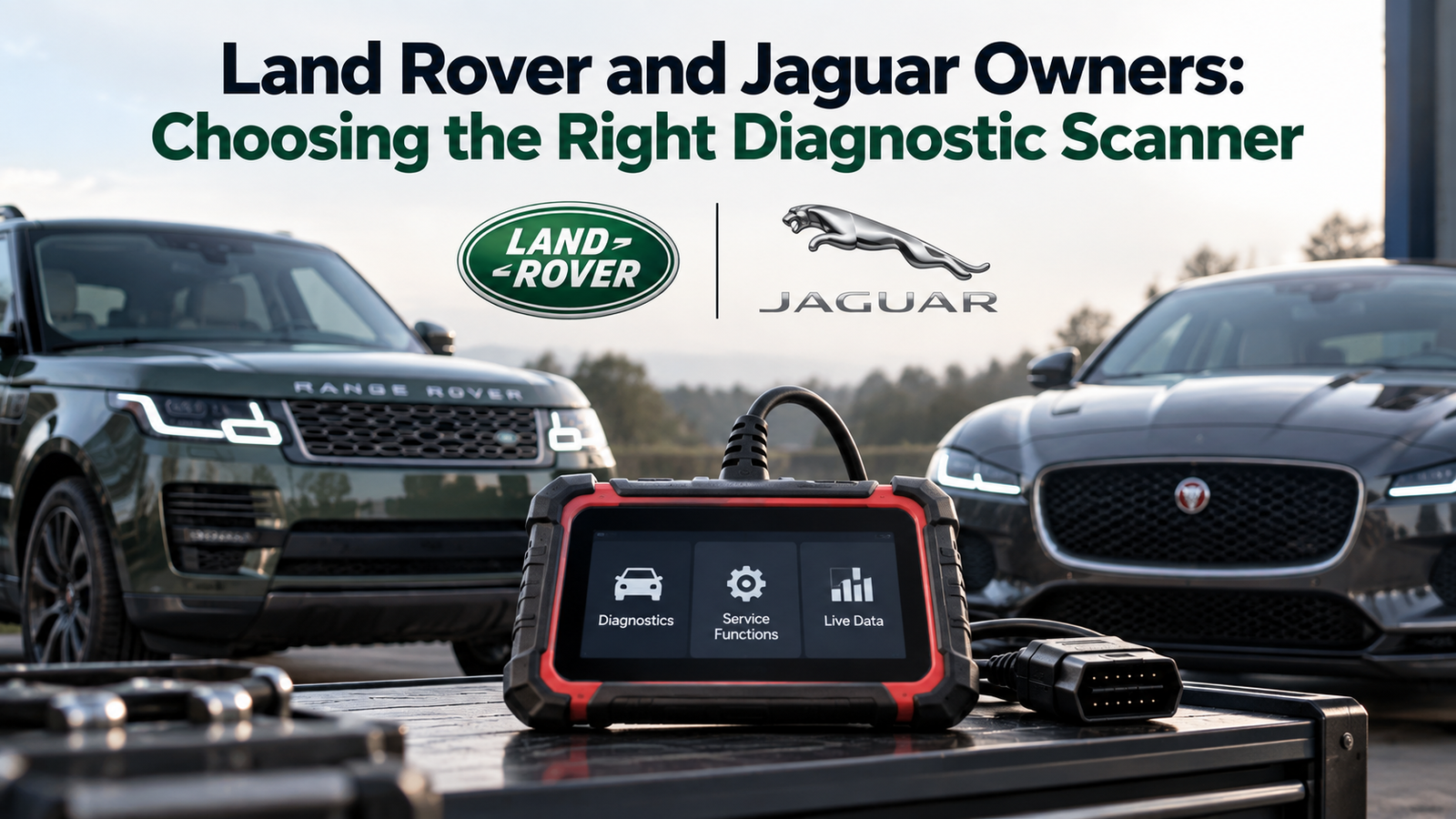
There’s a persistent idea that Land Rovers are simply unreliable, full stop. The truth is a bit more specific than that. In the latest What Car? Reliability Survey, Land Rover placed 27th out of 31 brands, but the newer Defender scored 96.3%, among the best results of any model in the whole survey. The pattern that runs through almost every result, old or new, isn’t mechanical failure. It’s electric: engine electrics, body electrics, infotainment, and the sensors that power them all. That single detail changes what actually matters when you’re choosing a scanner for one of these cars.
Why JLR Vehicles Ask More of a Diagnostic Tool
For their size, Land Rovers and Jaguars have an unusually large number of electronic control modules, including air suspension height sensors, adaptive dampers, several driver assistance cameras and a body control system that affects virtually every electrical component in the car. A generic scanner built to skim fault codes across forty other brands will read most of this well enough for basic diagnosis, but the depth needed to actually resolve a JLR-specific fault, rather than just identify that one exists, is a different matter entirely.
That’s where many owners trip up. A scanner tells them there’s a fault on the air suspension module, but doesn’t tell them to run the calibration that actually removes the fault, nor reset the variant of a system that a 2016 Discovery uses compared to a 2019 Discovery. It is the difference between a tool that can point at a problem and a tool that can actually complete a task, and on these two brands in particular, the difference is more evident than on an average family hatchback.
Part of the reason comes down to how JLR models are built. These vehicles don’t rely on a single computer to perform most of the tasks – instead, dozens of separate modules all have to communicate properly, with the air suspension module communicating with the ride height sensors, the body control module communicating with the electrics on the doors and windows, and so on. When one link in that chain reports an error, a basic scanner sees the symptom. A well-constructed one can backtrack the fault through the chain to the point of origin.
The Faults That Come Up Again and Again
Some issues are common enough on these platforms that most independent JLR specialists could probably list them from memory.
On the Land Rover Side
- Air suspension compressor and valve block faults, especially on Range Rover, Range Rover Sport, and Discovery models that have covered high mileage
- Timing chain tensioner wear on certain Td6 and Si4 diesel and petrol engines, which needs careful fault interpretation rather than a straight code-and-clear
- EGR and DPF-related faults on diesel variants doing a lot of short journeys
- Electrical faults traced to body control modules affecting central locking, window regulators, or dashboard warning lights that don’t match the actual problem
On the Jaguar Side
- Air suspension and adaptive damping faults on the F-Pace and XF, similar in nature to Land Rover’s but running different software
- Electrical faults around the infotainment and instrument cluster, an area Jaguar owners report almost as often as Land Rover owners do
- Fault codes on the I-Pace that need careful handling given its electric drivetrain sits alongside the same body and chassis systems used across the rest of the range
Why a Wrong Diagnosis Costs More on These Cars Than Most
Misdiagnosis is expensive everywhere, but it’s particularly punishing on Land Rovers and Jaguars because parts and labour both sit at the higher end of the market. Replacing an air suspension compressor unnecessarily, when the actual fault was a leaking air spring or a faulty height sensor, can mean paying for a part that never needed replacing on top of the one that did. Main dealer diagnostic time is billed by the hour, and a fault that a properly equipped independent could isolate in twenty minutes can take considerably longer to chase down with a tool that only tells you which module raised a flag, not why.
This is also where the earlier point about distributed control modules bites hardest. A warning light for one system can just as easily be caused by a related module failing to communicate with it, rather than the system itself being broken. Getting that distinction right the first time, rather than replacing parts on a hunch, is where a genuinely capable scanner earns back its price within the first job or two.
Choosing a Tool That Actually Handles These Systems
A capable JLR scanner needs to go past reading and clearing codes into the functions that actually fix the recurring problems above: per-corner air suspension calibration and ride height sensor initialisation, bi-directional tests on suspension valves and the compressor, steering angle sensor reset after wheel alignment work, and forced DPF regeneration with live soot monitoring on the diesel models that need it. If a scanner can’t run these, it can tell you something’s wrong, but not put it right. The iCarsoft LR V4.0, for instance, is built specifically around this set of functions for Land Rover and Jaguar models.
It’s also worth checking coverage against your specific model rather than assuming “Land Rover” or “Jaguar” support covers everything equally. Coverage tends to be strongest on mainstream models like the Discovery, Range Rover Sport, F-Pace and XF, and can be thinner on lower-volume variants or anything genuinely new to the range, so confirming compatibility for your exact model and year before buying saves a wasted purchase later.
Live data matters just as much here as fault codes do. Being able to watch ride height readings from all four corners simultaneously while the compressor cycles, for instance, tells you far more about a slow air suspension leak than a stored code ever will, since some intermittent faults simply won’t be sitting there as a saved code at all by the time you plug in. A tool that only reads what’s already logged, without giving you a live view of what the sensors are doing right now, misses this category of fault entirely.
Jaguar Isn’t Just “Land Rover With a Different Badge”
It’s a common assumption, understandable given the shared ownership, but the two brands don’t run identical systems underneath. Some platforms and components are genuinely shared, the F-Pace and Velar sit on closely related underpinnings, for instance, but Jaguar’s own software, model-specific service functions, and electrical architecture differ enough that a tool needs proper coverage of both marques individually rather than treating one as a stand-in for the other. A scanner that’s excellent on Land Rovers can still fall short on a Jaguar it technically “supports” if that support wasn’t built out with the same depth.
This matters more for mixed-fleet independents than it does for a one-car household, simply because the mistake is easier to make at scale. A garage that’s built genuine expertise on Discoverys and Range Rovers can reasonably assume their tool handles an XF or F-Pace just as well, right up until a Jaguar-specific service function turns out to be missing or only partially supported. Checking both brands separately against your actual workload, rather than assuming coverage of one implies the other, avoids finding this out mid-job.
What This Looks Like in Practice
For owners and independent garages dealing with both brands regularly, an iCarsoft Land Rover Jaguar scanner is built specifically around this pairing rather than treating JLR as one line item among forty other manufacturers. That means the functions covered above, air suspension calibration, bi-directional valve and compressor tests, SAS reset, DPF regeneration, are built in for both brands rather than offered as a token gesture toward one badge while barely touching the other. Albionshire stocks the wider range of iCarsoft scanners too, if you’re weighing up a JLR-specific tool against something that covers a mixed fleet instead.
Whichever tool you land on, the test is the same: does it go beyond telling you what’s wrong, into actually letting you fix it. On these two brands in particular, that gap between reading a code and resolving the fault is exactly where most of the frustration lives, and it’s usually the difference between a job that gets finished the same day and one that sits on the ramp for a week while parts get ordered on a guess.
None of this is a reason to think twice about owning a Land Rover or Jaguar. The reliability picture has genuinely improved on the newer models, and most of what goes wrong on either brand is well understood and entirely fixable, provided whoever’s diagnosing it has a tool built for the job rather than one that’s merely compatible with it on paper.
