
 mohammed Saleem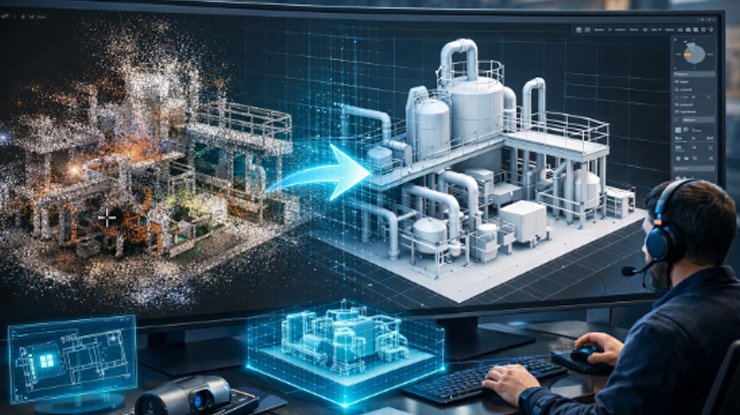
Across the USA and UK, architecture and construction projects are moving faster than ever. From infrastructure modernization in London to commercial retrofits in New York, one thing has become clear: accurate digital documentation is no longer optional.
Yet many projects still begin with outdated drawings, incomplete plans, or missing documentation.
That’s where Scan to CAD Conversion Services are transforming the industry.
By converting raw point cloud data into precise 2D drawings and intelligent 3D models, businesses can bridge the gap between physical structures and digital workflows with accuracy, efficiency, and confidence.
For business owners, architects, engineers, and tech decision-makers, understanding how Scan to CAD Conversion Services work and why they matter can significantly reduce project risks and improve ROI.
What Are Scan to CAD Conversion Services and Why Do They Matter?
Scan to CAD Conversion Services involve converting 3D laser scan data (point clouds) into editable CAD drawings and BIM-ready models.
Laser scanners capture millions, sometimes billions of spatial data points. These points represent the exact geometry of a structure.
However, point clouds alone are not usable for:
- Renovation planning
- Structural analysis
- Permit submissions
- BIM coordination
- Cost estimation
This is where professional CAD conversion comes into play.
Through advanced software and expert interpretation, raw scan data is converted into:
- Detailed floor plans
- Elevations and sections
- 3D solid models
- Revit BIM models
- Accurate as-built documentation
Without proper conversion, even the most detailed scan data has limited value.
Why Is Demand Growing for CAD Conversion Services in USA and UK?
The growth is not accidental it’s driven by infrastructure renewal and digital transformation mandates.
In the UK, the UK Government continues investing heavily in infrastructure modernization and smart city development. Meanwhile, in the United States, the U.S. Department of Transportation is funding major redevelopment projects under federal investment programs.
According to McKinsey & Company, large construction projects typically take 20% longer to finish than scheduled and can exceed budgets by up to 80%.
One of the key causes?
Inaccurate documentation.
This is why CAD Conversion Services in USA and the UK are increasingly becoming foundational to project planning especially for renovations and adaptive reuse projects.
How Does the Scan to CAD Conversion Process Work?
If you’re evaluating Customized CAD Conversion Services, here’s how the workflow typically unfolds:
1. 3D Laser Scanning
High-precision scanners capture site conditions with millimeter-level accuracy.
2. Point Cloud Registration
Multiple scans are aligned into one unified dataset.
3. CAD Modeling & Drafting
Experts convert the point cloud into structured 2D and 3D outputs.
4. Quality Verification
Dimensions are cross-checked against scan data.
5. Final Deliverables
Clients receive DWG, DXF, RVT, or IFC files ready for design integration.
This structured approach ensures clarity, precision, and compliance.
Why Are 2D CAD Conversion Services Still Essential?
With so much focus on 3D modeling, many assume 2D is outdated.
It’s not.
2D CAD Conversion Services remain critical for:
- Planning permissions
- Building permit submissions
- Fabrication drawings
- Shop drawings
- Structural approvals
Local authorities in both the USA and UK often require dimensioned 2D drawings for compliance. Even when BIM models exist, regulatory processes still rely heavily on clear 2D documentation.
For businesses looking to accelerate approvals, high-accuracy 2D outputs derived from scan data can significantly reduce revisions.
What Problems Do Businesses Face Without Professional Scan to CAD Conversion Services?
Skipping professional Scan to CAD Conversion Services can create serious downstream risks:
- Design clashes during construction
- Incorrect structural interpretations
- Cost overruns
- Rework and material waste
- Project delays
For example, a small measurement deviation in a retrofit project can disrupt MEP coordination or custom millwork fabrication.
For startups and SMEs, these errors aren’t just inconvenient, they’re expensive.
Accurate CAD conversion acts as a risk mitigation strategy.
How Are Customized CAD Conversion Services Adding More Value?
No two projects are identical.
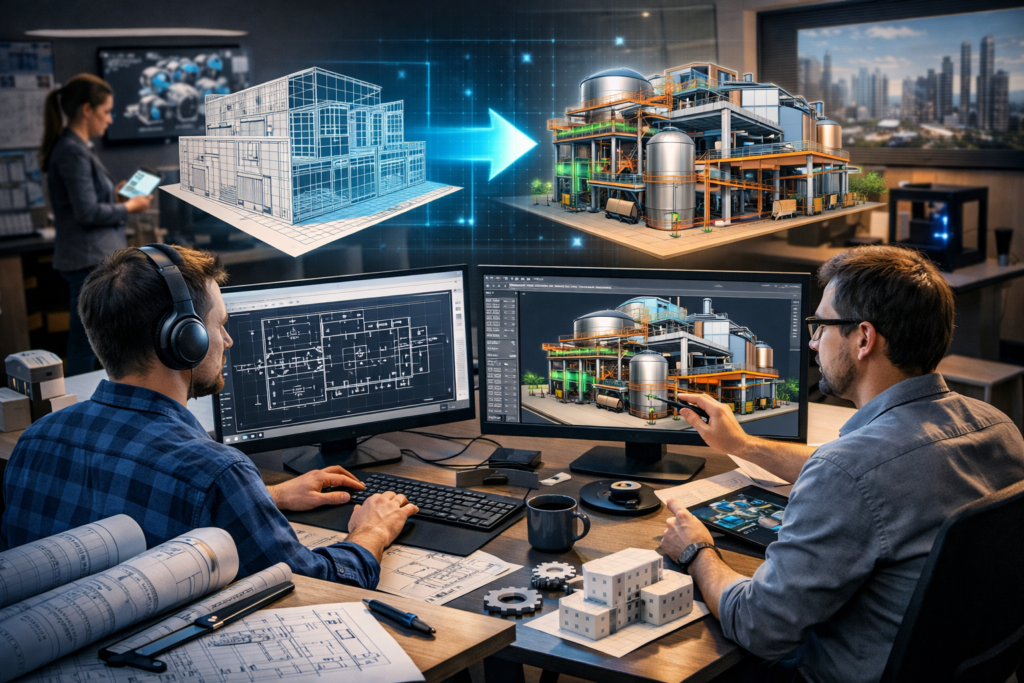
This is why Customized CAD Conversion Services are gaining traction.
Instead of one-size-fits-all modeling, businesses can request:
- Specific LOD (Level of Detail) outputs
- Discipline-specific drawings (MEP, structural, architectural)
- BIM integration
- Clash detection readiness
- Digital twin compatibility
Customization ensures that clients pay only for what they need while maintaining technical precision.
For technology-driven firms, this flexibility is essential.
How Is AI Changing Scan to CAD Workflows?
Artificial intelligence is starting to accelerate the point cloud interpretation process.
Modern software can:
- Detect walls and floors automatically
- Identify structural elements
- Reduce manual tracing time
However, complex environments such as heritage buildings in London or multi-level commercial spaces in Chicago still require expert human oversight.
The future of Scan to CAD Conversion Services lies in hybrid workflows:
AI-assisted automation + skilled CAD professionals.
This balance ensures speed without compromising accuracy.
Which Industries Benefit Most from Scan to CAD Conversion Services?
The application scope is broader than many realize.
Architecture & Construction
Renovations, adaptive reuse, and BIM coordination rely heavily on precise digital modeling.
Commercial Real Estate
Retail chains and property developers use CAD Conversion Services in USA to standardize layouts across multiple locations.
Manufacturing & Industrial
Reverse engineering and equipment layout planning benefit from accurate as-built models.
Healthcare Facilities
Hospitals upgrading infrastructure require exact spatial documentation to avoid operational disruptions.
Infrastructure & Transport
Rail stations, airports, and highways depend on accurate modeling before redevelopment.
Across sectors, the value remains the same: reduced uncertainty.
How Do Scan to CAD Conversion Services Improve ROI?
For decision-makers, investment must translate into measurable returns.
Here’s how Scan to CAD Conversion Services create ROI:
1. Reduced Rework Costs
Accurate models minimize design errors.
2. Faster Design Cycles
Engineers can begin planning immediately.
3. Improved Stakeholder Collaboration
Digital files enable cross-border teamwork.
4. Better Budget Forecasting
Precise geometry improves cost estimation accuracy.
5. Long-Term Asset Intelligence
Models support facility management and digital twin strategies.
In competitive markets like the USA and UK, efficiency directly impacts profitability.
Why Is Accuracy So Critical in Modern Infrastructure Projects?
Urban density is increasing. Retrofit projects are rising. Sustainability targets are tightening.
With net-zero commitments across the UK and USA, reducing material waste is a priority.
Accurate CAD models:
- Prevent over-ordering materials
- Minimize demolition errors
- Improve prefabrication precision
- Support ESG goals
For large-scale redevelopment, even small improvements in accuracy can translate into substantial cost savings.
What Should Businesses Look For When Choosing CAD Conversion Services in USA or UK?
Selecting the right provider requires careful evaluation.
Key factors include:
- Experience handling large point cloud datasets
- Strong QA/QC processes
- BIM expertise
- Compliance with regional building standards
- Data security measures
Communication clarity and time zone alignment are also critical for international projects.
Choosing a partner is not just about price, it’s about reliability and technical capability.
Is Scan to CAD Suitable for Startups and Growing Firms?
Yes and increasingly so.
Technology costs are decreasing. Outsourcing options are expanding. Smaller firms no longer need expensive scanning equipment in-house.
By leveraging professional Scan to CAD Conversion Services, startups gain:
- Access to expert drafting teams
- Scalable project support
- Faster turnaround times
- Reduced operational overhead
For proptech and smart infrastructure startups, digital accuracy becomes a competitive advantage.
The Future of Scan to CAD Conversion Services in the USA and UK
The global 3D scanning market continues to grow rapidly, driven by smart cities, digital twins, and infrastructure renewal.
As projects become more complex, the demand for:
- Customized CAD Conversion Services
- High-accuracy 2D CAD Conversion Services
- BIM-integrated outputs
- Reality capture solutions
will continue expanding.
Businesses that adopt structured digital workflows today will be better positioned for tomorrow’s regulatory, sustainability, and efficiency demands.
Final Thoughts:
From heritage preservation projects in London to commercial redevelopment in New York, accurate digital documentation is now foundational to success.
Scan to CAD Conversion Services transform raw point cloud data into reliable, structured models that empower smarter planning and execution.
For organizations in the UK, USA, and globally, partnering with an experienced CAD design specialist ensures precision, compliance, and long-term value. Leading UK CAD design companies are now combining advanced reality capture expertise with customized drafting solutions to support complex, future-ready projects.
In today’s competitive construction landscape, precision isn’t just technical, it’s strategic.
FAQS
What are Scan to CAD Conversion Services?
Scan to CAD Conversion Services involve converting 3D laser scan data (point clouds) into accurate 2D drawings and 3D CAD models. These services help architects, engineers, and contractors transform real-world site conditions into editable digital files for renovation, construction, and BIM workflows.
How do Scan to CAD Conversion Services improve construction accuracy?
Scan to CAD Conversion Services improve accuracy by using millimeter-level laser scan data to create precise as-built drawings. This reduces design clashes, prevents costly rework, and ensures that renovation or retrofit projects align with actual site conditions.
Why are CAD Conversion Services in USA growing rapidly?
CAD Conversion Services in USA are growing due to infrastructure modernization, adaptive reuse projects, BIM mandates, and increasing renovation demand. Accurate digital documentation reduces project delays and supports federal and state compliance requirements.
What is the difference between Scan to CAD and 2D CAD Conversion Services?
Scan to CAD converts point cloud data into 2D or 3D CAD files.
2D CAD Conversion Services specifically focus on producing floor plans, elevations, and sections required for permits, approvals, and fabrication drawings.
Both services are often used together for complete project documentation.
Are Customized CAD Conversion Services suitable for small businesses?
Yes. Customized CAD Conversion Services allow startups and SMEs to request only the level of detail they need. This makes digital modeling affordable while ensuring compliance and project precision.
How accurate are point cloud to CAD conversions?
Professional Scan to CAD Conversion Services can achieve millimeter-level accuracy, depending on scan quality and project scope. Accuracy is validated through quality control processes and alignment checks with original scan data.
How do Scan to CAD services support permit approvals in UK and USA?
Scan to CAD services generate precise 2D drawings and as-built documentation required by local authorities in the UK and USA. Accurate documentation reduces revision requests and speeds up planning and building permit approvals.
